

Rimzim Dadu’s INLAE Turned Mother-of-Pearl into One of Couture Week’s Most Fascinating Materials
Photography Shazid Chauhan
An 80-foot kinetic installation transformed the space into a constantly shifting environment where light, movement, and reflection became part of the presentation. The collection unfolded through approximately forty-five looks, each exploring the relationship between structure and movement that has become synonymous with the House. Sculptural saris shimmered under the lights, fringed skirts reflected every movement, while sharply tailored bandhgalas and bombers continued Rimzim Dadu’s exploration of the space between couture, eveningwear, and contemporary dressing.

This wasn’t a collection built around embellishment or silhouette alone. The focus was the material itself—and the possibilities it offered.
Mother-of-pearl, long associated with heirloom jewelry and decorative objects, became the defining element of the collection. Under the runway lights, its iridescent surface revealed flashes of silver, ivory, and soft champagne, changing with every movement. Photographs will capture the craftsmanship, but they cannot fully convey the way these textiles responded to light on the runway.


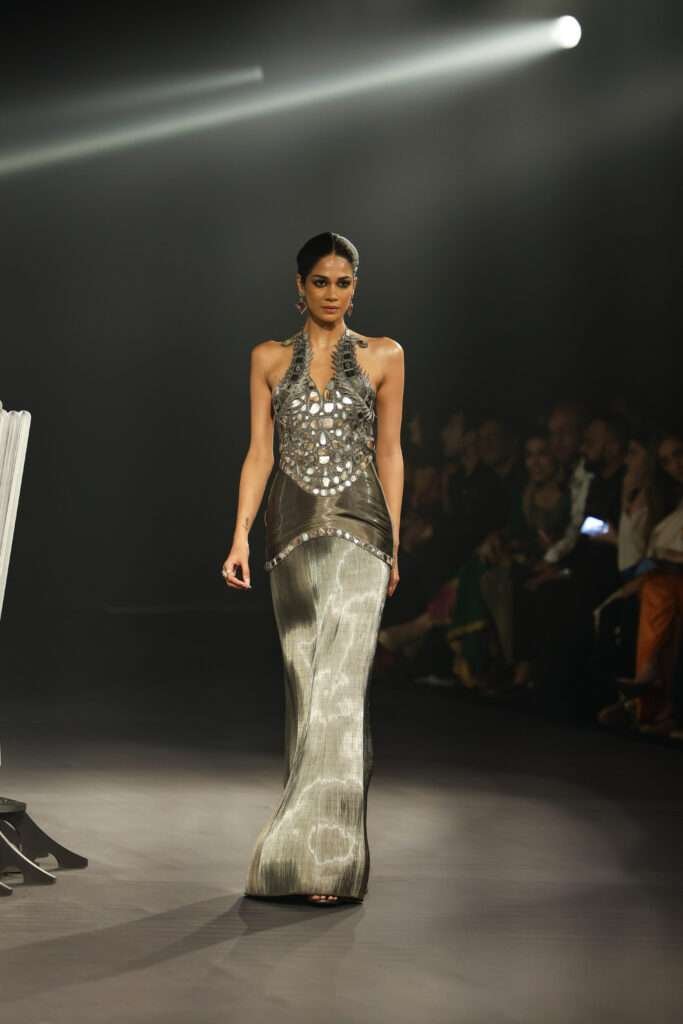

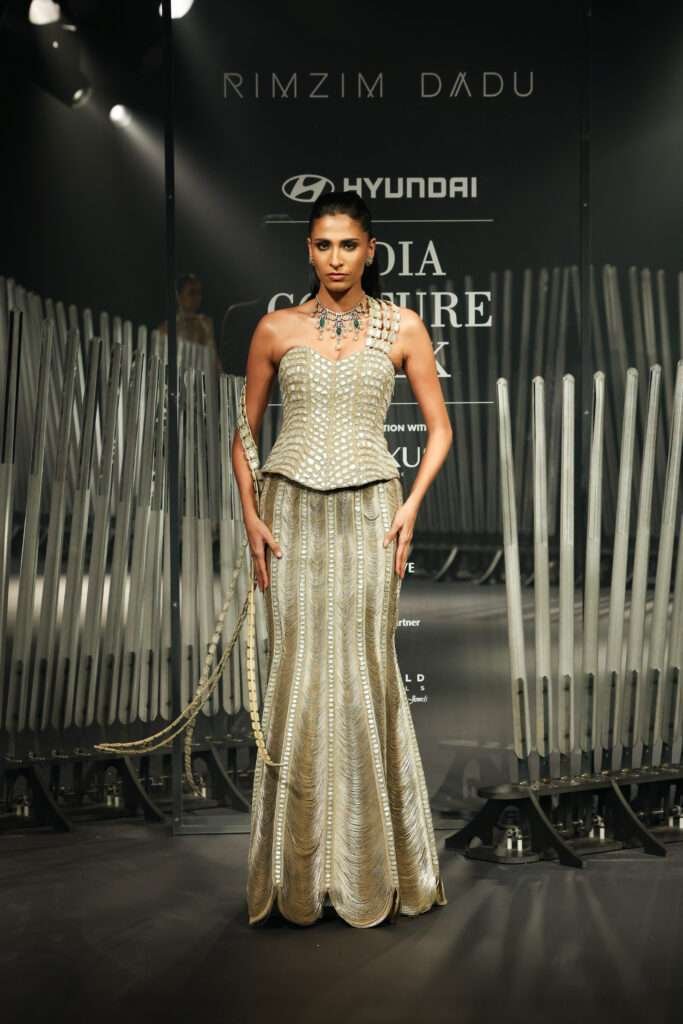




With INLAE, centuries-old Mughal inlay techniques and traditional stone-setting practices became the foundation for a new textile vocabulary, bringing together couture craftsmanship, jewelry techniques, and material innovation.



Thousands of individually cut and hand-set pieces of mother-of-pearl were woven into Rimzim Dadu’s signature metallic textiles, creating surfaces that carried the intricacy of fine jewelry while remaining surprisingly fluid. Up close, the craftsmanship was extraordinary; on the runway, the garments moved with an ease that made the technical complexity almost disappear.
Every textile reflected months of research and development. Steel appeared softer, mother-of-pearl responded to movement, and familiar materials were reworked in ways that felt unexpected without losing their original character.
Material innovation has always been central to Rimzim Dadu’s work, and INLAE continued that conversation through mother-of-pearl. Mughal inlay traditions and stone-setting techniques were reinterpreted as couture textiles, introducing a fresh perspective while remaining rooted in Indian craftsmanship.
Among collections defined by embroidery and surface embellishment, INLAE offered a different point of view. Mother-of-pearl became the foundation of the collection, demonstrating how traditional craft techniques can evolve through material innovation while retaining the precision and artistry of hand craftsmanship.

